
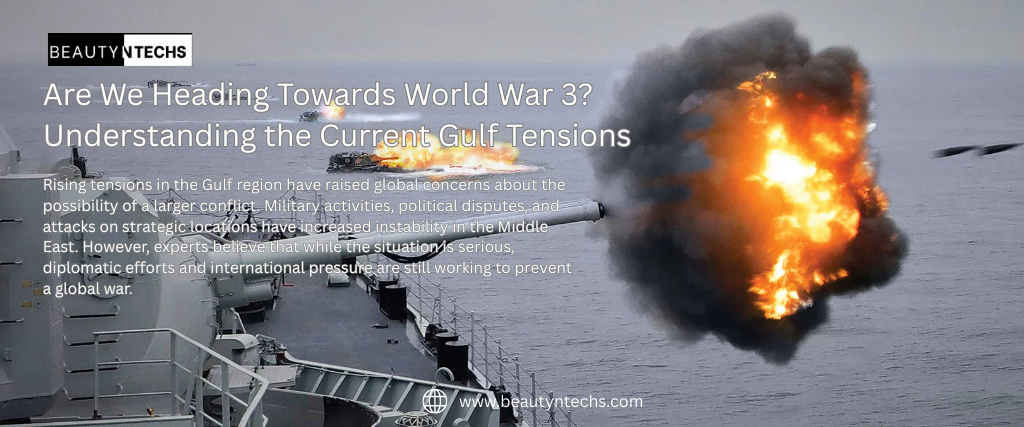
In recent years, geopolitical tensions in the Gulf and broader Middle East region have once again drawn global attention. News headlines, social media debates, and political discussions frequently raise a worrying question: Are we moving toward another global conflict, possibly even World War 3?
While the phrase “World War 3” is often used dramatically online, the current situation is more complex. The Gulf region has always been strategically important because of its energy resources, geographic location, and political alliances. As tensions rise between nations and global powers become increasingly involved, concerns about wider conflict naturally follow.
Understanding these developments requires examining geopolitics, economic interests, military alliances, and the role of nuclear powers, as well as the broader implications for humanity and the planet.
The Strategic Importance of the Gulf Region
The Gulf region, which includes countries such as Saudi Arabia, Iran, the United Arab Emirates, Qatar, Kuwait, and Iraq, holds enormous global significance. A large percentage of the world’s oil and natural gas supply passes through this region, particularly through the Strait of Hormuz, one of the most important shipping routes in the world.
Because energy supply directly affects global economies, any instability in this region can quickly become a global issue. Major powers—including the United States, Russia, China, and European nations—have strong strategic interests in maintaining influence there.
This is why tensions in the Gulf often attract global attention and diplomatic involvement.
Key Geopolitical Factors Behind Rising Tensions
Several factors contribute to the current geopolitical environment in the region.
1. Regional Rivalries
One of the main drivers of tension is the longstanding rivalry between Iran and several Gulf states, particularly Saudi Arabia. These rivalries involve political influence, ideological differences, and competition for leadership in the region.
Proxy conflicts and political competition across neighboring countries have deepened mistrust and instability.
2. Global Power Competition
The Gulf region has become a stage where global powers compete for influence. Nations such as the United States, Russia, and China maintain strategic partnerships, military bases, or economic ties with countries in the region.
This overlapping network of alliances increases the risk that local conflicts could draw in larger powers.
3. Energy Security and Economic Interests
Control over energy resources has long been a central factor in geopolitical conflicts. The Gulf holds some of the world’s largest oil reserves, and any disruption in supply can have enormous economic consequences.
Energy markets, trade routes, and international investments are therefore deeply connected to political stability in the region.
4. Military Presence and Arms Expansion
The Gulf region also has a high concentration of military forces and advanced weapons systems. Several countries maintain powerful armed forces and defense alliances.
While these capabilities are intended for national security, the presence of large militaries can also increase the risk of escalation if tensions rise.
Why Some People Are Linking Current Events to “World War 3”?
Online discussions often amplify global fears, and the term World War 3 frequently appears whenever geopolitical tensions escalate. This is partly due to the interconnected nature of today’s world.
In a globalized environment, conflicts rarely remain isolated. Political alliances mean that disputes between two nations could potentially involve others.
However, experts generally caution that large-scale global wars are far more complex than viral headlines suggest. Diplomacy, international organizations, and economic interdependence play major roles in preventing escalation.
Why Some Online Discussions Mention the “Epstein Files”?
Another topic occasionally linked to geopolitical tensions in online conversations is the controversy surrounding Jeffrey Epstein and the so-called Epstein files. These discussions often appear in social media debates where people speculate about hidden political or elite networks influencing global events.
It is important to note that such claims are largely speculative and not supported by verified geopolitical evidence. Experts emphasize that international conflicts are usually driven by economic interests, political power struggles, territorial disputes, and security concerns, rather than the conspiracy theories that often circulate online.
Responsible analysis requires focusing on verified geopolitical factors rather than unproven narratives.
Nuclear Powers and the Global Risk Factor
One of the reasons people worry about global conflict is the presence of nuclear weapons. Several powerful nations possess nuclear arsenals, and the idea of nuclear escalation raises understandable fears.
Modern diplomacy and international treaties aim to reduce this risk. Organizations such as the United Nations and various non-proliferation agreements work to prevent nuclear weapons from being used.
While tensions may rise, global leaders are generally aware that nuclear conflict would have catastrophic consequences for all of humanity.
The Impact on Humanity and Planet Earth
Beyond politics and military strategies, any large-scale war would have devastating consequences for humanity and the environment.
Modern warfare affects far more than battlefields. It can disrupt:
- Global economies
- Food supplies
- Climate stability
- International cooperation
- Civilian safety
Large conflicts also leave long-term environmental damage. Industrial pollution, destroyed infrastructure, and potential nuclear contamination could harm ecosystems for generations.
In an age where humanity already faces global challenges such as climate change, environmental degradation, and resource scarcity, conflict would only worsen these crises.
Lessons from History
History offers sobering reminders of the cost of global conflict. The two world wars of the twentieth century caused millions of deaths, massive displacement, and widespread destruction.
Cities were reduced to rubble, economies collapsed, and entire generations were shaped by trauma and loss. Even decades later, the political and social consequences of those wars still influence international relations.
These historical lessons reinforce why diplomacy and conflict resolution remain essential.
The Role of Diplomacy and International Cooperation
Despite tensions, the modern world also has stronger systems for preventing escalation. International diplomacy, global institutions, and economic cooperation create incentives for peace.
Countries today are connected through trade, technology, and cultural exchange in ways that did not exist a century ago. This interdependence makes large-scale war far less desirable for most nations.
Dialogue, negotiation, and multilateral agreements continue to be the primary tools for resolving disputes.
What Humanity Stands to Lose?
At its core, the discussion about global conflict is not only about politics or strategy—it is about human life and the future of our planet.
War threatens everything that societies work to build: education, culture, innovation, and progress. It divides people, destroys communities, and interrupts generations of development.
Human history has shown that rebuilding after conflict takes decades, and the scars often last even longer.
In a world where humanity has the knowledge and technology to solve many of its greatest challenges, the ultimate loss in war is not just territory or power—it is the loss of human potential.
Conclusion
The rising tensions in the Gulf region reflect complex geopolitical realities involving energy resources, regional rivalries, and global power dynamics. While these developments deserve careful attention, it is important to approach the topic with balanced understanding rather than fear-driven speculation.
Global conflicts are rarely inevitable. Through diplomacy, cooperation, and responsible leadership, nations can continue working toward stability and peace.
The lessons of history remind us that humanity’s greatest achievements come not from conflict, but from collaboration. Protecting our shared future—our societies, our environment, and our planet—requires prioritizing dialogue over division.
Ultimately, the true goal should not be preparing for another world war, but ensuring that humanity never repeats the tragedies of the past.