
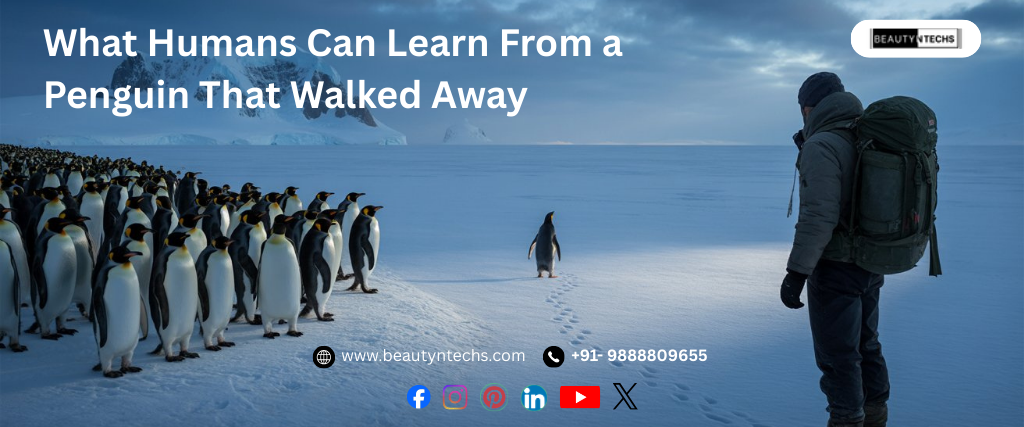
There’s something powerful about the image of a single penguin stepping away from a tightly packed colony and walking toward the endless white. It feels symbolic. Brave. Lonely. Rebellious. Last month’s viral “runaway penguin” story sparked global curiosity. Headlines framed it as a dramatic escape — a penguin leaving its troop, abandoning its colony, choosing solitude. Social media turned it into metaphor. Some saw independence. Others saw isolation. A few saw survival instinct at work.
But what does science actually say? And more importantly — what can humans genuinely learn from a penguin that walked away? Let’s break this down properly: biology, migration theory, behavioral science, myths vs. facts, and the surprising psychological parallels between humans and animals.
First, The Reality: Penguins Don’t “Run Away”
Penguins don’t leave their colony because of emotional conflict, boredom, or rebellion. That’s human storytelling layered onto animal behavior. In wildlife biology, when a penguin separates from its group, the reasons usually fall into one of these categories:
- Juvenile exploration behavior
- Navigation error during migration
- Food scarcity forcing movement
- Predator avoidance
- Climate and environmental disruption
- Breeding displacement
Especially in species like the Emperor Penguin, migration patterns are driven by sea ice conditions and food availability — not emotional decisions. That said, animals do make choices. Not emotional in the human sense, but adaptive. Penguins respond to stimuli, environmental signals, and survival cues. When something changes, they adjust. And that’s our first lesson.
Lesson 1: Survival Requires Adaptation, Not Comfort
Penguins live in some of the harshest environments on Earth — Antarctica, sub-Antarctic islands, South Africa, South America, Australia, and New Zealand. Take the Adélie Penguin or the King Penguin. Their survival depends on:
- Sea ice stability
- Krill and fish populations
- Temperature shifts
- Ocean currents
When climate patterns change — and they are changing rapidly due to global warming and melting ice caps — penguins must relocate or adjust breeding grounds. There is no “loyalty to location.” There is loyalty to survival. Humans, on the other hand, often cling to familiarity — jobs, routines, social groups — even when they are no longer serving us. The penguin that walks away isn’t abandoning the colony.
It’s responding to reality.
Penguin Migration Theories: What Science Has Discovered
Over decades, marine biologists have studied penguin migration patterns using satellite tracking and behavioral observation. Some key theories include:
1. Navigational Imprinting
Young penguins learn migratory routes through early-life exposure. If disrupted, they may wander.
2. Foraging Efficiency Theory
Penguins will travel farther if prey density decreases. This is especially visible in species like the Gentoo Penguin.
3. Ice Edge Tracking Theory
Species such as the Chinstrap Penguin follow the shifting edge of sea ice. If the ice moves unpredictably, so do they.
4. Climate Displacement Theory
Global warming has altered breeding timing and habitat safety. Some colonies are shrinking because food sources are migrating. None of these theories involve “rebellion.” They involve survival intelligence.
Myths vs. Facts About Penguins
Let’s clean up the noise.
Myth 1: Penguins Mate for Life
Partially true.
Many species show seasonal monogamy, but not lifelong loyalty. If a partner doesn’t return, they choose another.
Myth 2: Penguins Are Always United
Colonies provide warmth and safety, yes. But individuals frequently separate during foraging and migration.
Myth 3: Penguins Are Emotionally Simple
Modern research suggests birds possess complex cognitive and social awareness. They recognize partners, respond to vocal signatures, and adapt behavior. But they do not hold grudges. They do not stage dramatic exits. They respond to stimulus and necessity. That’s a powerful contrast with human emotional complexity.
The Human Parallel: Instinct vs. Emotion
Here’s where things get interesting. Humans are animals too. Our brains evolved from survival-driven ancestors. We share basic neural mechanisms — fear response, attachment, pattern recognition. But we added narrative. When a person leaves a community, changes careers, moves cities, or walks away from a social group, we interpret it emotionally: courage, betrayal, independence, failure. A penguin leaving a colony is none of those things.
It’s adaptation.
In psychology, there’s a concept called behavioral flexibility — the ability to adjust behavior in response to environmental change. Studies in animal cognition show that species with higher flexibility survive better in unstable climates. Humans struggle with this. We build identities around stability.
Nature doesn’t.
Loneliness vs. Solitude: A Shared Biological Reality
Penguins gather in colonies for warmth and protection. Huddling behavior in extreme Antarctic storms is life-saving. Humans gather for emotional safety. But both species also require individual action. Penguins forage alone or in small groups. They explore. They assess. The viral “lonely penguin” image resonates because humans project their own fear of isolation onto it. In reality, short-term separation can be strategic. For humans too. Innovation rarely comes from the middle of the crowd.
Climate Change: The Bigger Picture
Let’s address the global elephant in the room. Climate change has significantly impacted penguin populations. Rising ocean temperatures affect krill availability — a primary food source. Melting ice destabilizes breeding grounds. The World Wildlife Fund reports that several penguin species face population decline due to habitat loss and ocean changes. So when we see a penguin “walking away,” sometimes it’s not choice. It’s displacement. And here’s the uncomfortable human lesson: our industrial decisions affect ecosystems far beyond our immediate visibility. The penguin walking alone may represent environmental imbalance — not individual rebellion.
Animal Mentality vs. Human Mentality
Let’s talk cognitive science.
Animals operate primarily through:
- Instinct
- Conditioning
- Environmental response
- Survival optimization
Humans operate through:
- Instinct
- Emotion
- Social constructs
- Cultural narrative
- Long-term planning
We complicate survival with ego.
A penguin doesn’t ask:
“What will the colony think?”
“What if I fail?”
“Am I different?”
It asks, biologically:
“Is there food?”
“Is it safe?”
“Is the environment viable?”
Sometimes the cleanest decisions are survival-driven.
What We Can Actually Learn?
Strip away the romantic metaphor. Here’s what remains practical:
1. Adapt Fast
Markets change. Climates change. Technology changes. Survival favors those who adjust early.
2. Don’t Mistake Comfort for Security
Colonies feel safe — until food runs out.
3. Move When the Environment Shifts
Waiting for consensus can be fatal in nature.
4. Stay Connected, But Think Independently
Penguins return to colonies to breed and survive harsh winters. Independence doesn’t eliminate community.
5. Simplicity Wins
Animals respond to reality. Humans often respond to imagined fears.
The Viral Story: Why It Resonated Globally
Search trends around “penguin leaving colony,” “lost penguin story,” and “penguin migration behavior” spiked because humans crave symbolic stories. We live in an era of burnout, career shifts, relocation, and digital migration. A penguin walking alone across ice mirrors the modern human stepping into uncertainty.
But here’s the grounded truth:
It’s not rebellion.
It’s navigation.
A Traditional Perspective: Nature Has Always Done This
For centuries, explorers, naturalists, and indigenous communities observed animal migration without dramatizing it.
Animals move. They always have.
The difference now is visibility. Satellite tracking, viral social media, and wildlife photography amplify normal behavior into global spectacle. Sometimes, we confuse observation with anomaly. The penguin walking away might not be rare at all. It’s just newly visible.
Final Thought: The Crowd Isn’t Always the Answer
Here’s the hard truth. Following the group feels safe. It reduces cognitive load. It spreads risk. But in both ecosystems and human societies, innovation and survival often begin with movement. That movement doesn’t need drama. It needs awareness. The penguin that walked away didn’t do it to inspire us. It did it because something changed. And when something changes, staying still is rarely the smartest strategy.
Closing Reflection
Maybe the most powerful lesson isn’t about courage or independence. Maybe it’s about clarity. Animals don’t overthink survival.
Humans do.
If the environment shifts — professionally, socially, environmentally — perhaps the real wisdom isn’t clinging to the colony. It’s recognizing when adaptation is necessary. Not because it’s poetic. Not because it’s rebellious. Because it’s practical. And nature has always rewarded the practical.